GSoC 2026 Week 6: Implementing the Security Scoring Engine
This week, I focused on implementing and finalizing Layer 3 (Scoring Engine & PHI classification) of our automated security pipeline.
Here is a breakdown of the design and architecture implemented this week.
Architecture & Component Overview
The security scoring engine runs as a post-processing stage in our pipeline, executed via a custom Laravel Artisan command:
1
2
3
4
5
6
7
8
9
10
11
12
13
[Layer 1: SAST/DAST Tooling]
   ├── composer-audit-report.json
   ├── phpstan-report.json
   └── zap_report.json
            │
            ▼
[Layer 2: Normalization]
   └── FindingNormalizer
            │
            ▼
[Layer 3: Risk Scoring Engine]
   ├── PhiClassifier (Classify: Critical PHI / Moderate PHI / Non-PHI)
   └── CvssScorer (CVSS Base Score + PHI Adjustment)
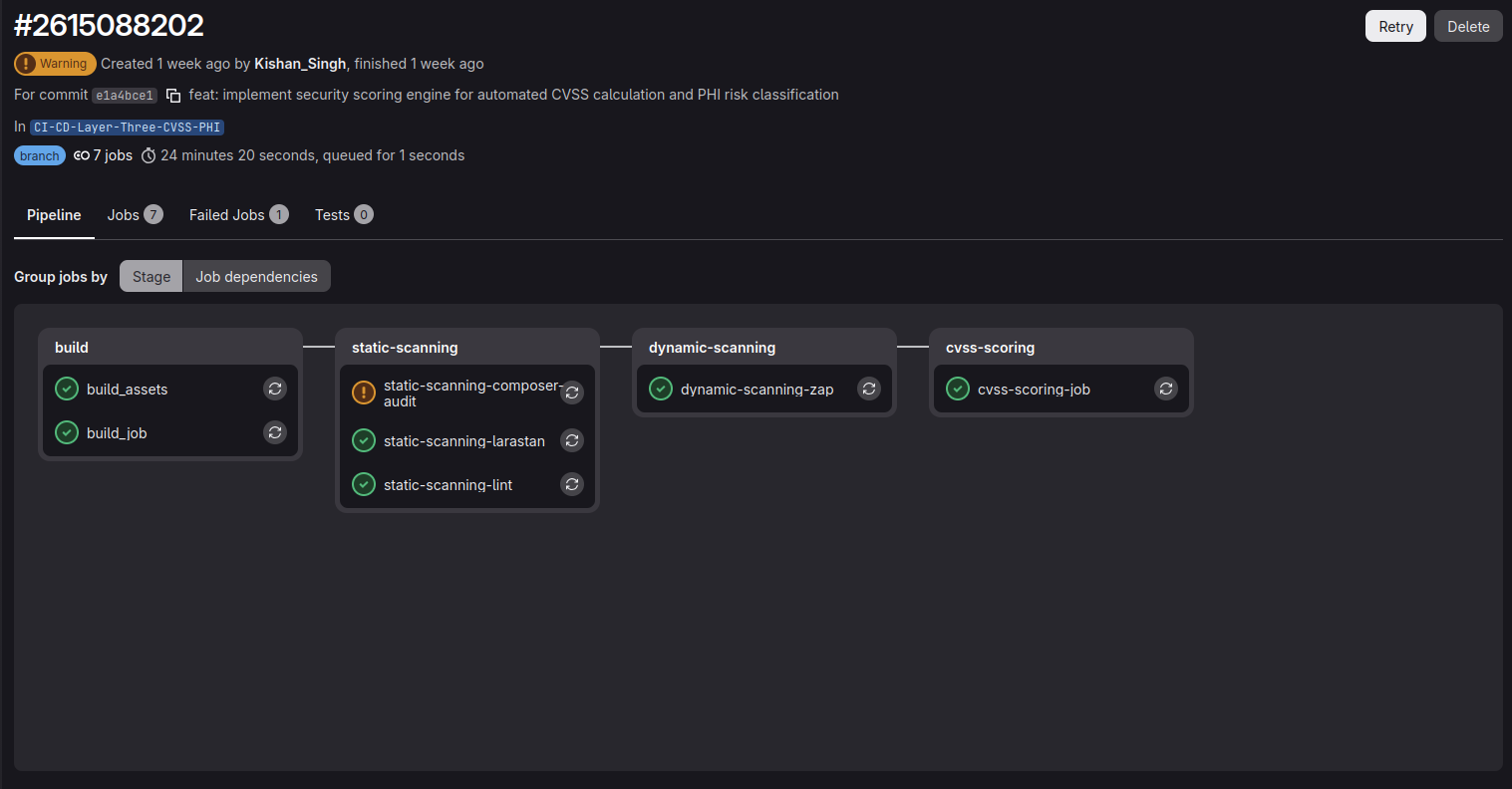
The updated pipeline features a dedicated cvss-scoring stage that runs after static and dynamic scanning jobs are complete:
MY Implementation
1. Data Models & Normalization
Standardized Finding DTO
To aggregate vulnerabilities from disparate formats, I created a unified Finding DTO. It holds identifiers, source markers, severity levels, target paths (file/line or URL), CWE mappings, base/adjusted scores, and scanner-specific metadata.
FindingNormalizer
This class converts raw scanner outputs into our standardized Finding DTOs:
- Composer Audit: Resolves package advisories (CWE-937) and maps abandoned packages (CWE-1104).
- PHPStan (Larastan): Maps static analysis errors, deduces files and lines, and uses basic text matching for severity heuristics.
- OWASP ZAP: Parses web application alerts, mapped URI endpoints, attack parameters, and solutions.
2. Risk Assessment & Classification
PhiClassifier
Not all vulnerabilities carry the same weight in healthcare environments. A vulnerability exposed on a patient encounter page is infinitely more dangerous than one on a general configuration page. The PhiClassifier matches paths and URLs to categorize exposure risks:
- 🔴 Critical PHI (e.g., patient, prescription, medicalhistory, diagnosis, encounter, facesheet, billing).
- 🟡 Moderate PHI (e.g., user, address, facility, calendar, appointment).
- 🟢 Non-PHI (default fallback).
CvssScorer
The scorer maps raw findings to standard CWEs and calculates base CVSS scores, then applies a risk-adjusted formula based on PHI exposure: \(\text{Adjusted Score} = \min(10.0, \text{Base Score} + \text{PHI Adjustment})\)
- Critical PHI Exposure: Base score $+ 2.0$
- Moderate PHI Exposure: Base score $+ 1.0$
Next Week Plan
Next week, I will focus on building the pipeline orchestrator and the last layer that is Trend Analysis. This will help us to track the security posture of the project over time and identify any regressions or improvements. I will also focus on caching the builds and other images and making the pipeline faster.
Acknowledgement
Thanks for following along on my GSoC journey. Stay tuned for more updates!